
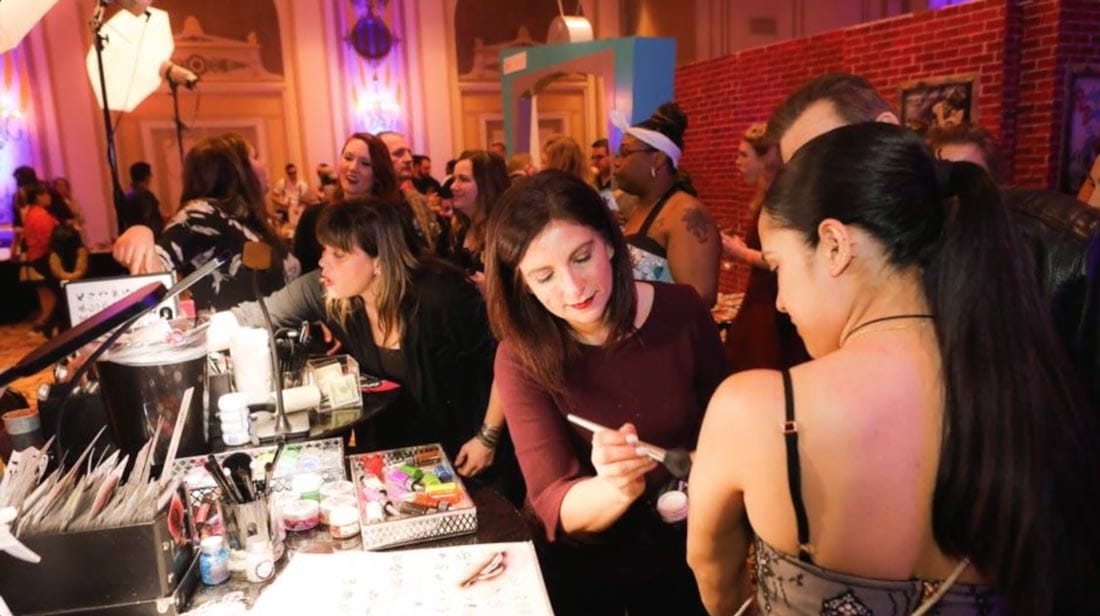
A planner’s breakdown of the design elements that turn a table into a destination.
Here’s a thing we’ve noticed after more than a decade of setting up interactive stations at every kind of event imaginable, from corporate trade shows with 5,000 attendees to backyard bat mitzvahs with fifty of a family’s favorite people.
Not all stations are created equal.
You can have a beautiful setup, the right materials, a perfectly trained artist, and still watch guests walk past. You can also have a simple table with the right elements in the right configuration and find yourself with a line fifteen people deep and a crowd gathered just to watch.
The difference is design, not luck.
There is an anatomy to a station that works, a set of elements that, when they’re all present and in sync, turn a table into a destination. We’ve been studying it, refining it, and building it into every activation we produce. We call it The Magnetic Table Method™, and this is how it works.
Element 1: Visible Curiosity
The first job of any interactive station is to make someone stop, not because they were planning to, but because they couldn’t help it.
This is harder than it sounds in a crowded event environment. Guests are distracted, drinks are in hand, conversations are already happening. Your station has approximately three seconds to compete with all of it.
The mistake most stations make is leading with the product: a display of finished items, a sign explaining the service, a tidy arrangement of materials. These are easy to read and easy to ignore. They answer the question before the guest even thought to ask it.
A magnetic station leads with process. Something is happening. Something is being made, applied, poured, stamped, or assembled, visibly, in real time. The guest sees motion before they see a sign. Their brain registers: something is going on over there, and that registration is what earns the stop.
This is why our glitter tattoo and live art stations consistently generate the most excited lines at mixed-format events. You can see the art being made. You can watch someone’s wrist transform in sixty seconds. That’s a show, and shows draw crowds.
Element 2: Low Barrier to Entry
Once a guest stops, the next question their brain asks, usually unconsciously, usually in about two seconds, is: is this for me?
If the answer isn’t immediately yes, they move on.
A station with a high barrier to entry is one where the guest has to figure something out before they can participate: a complicated process, a long wait with no visible end, a product that feels too precious to touch, or an artist who’s too focused to make eye contact. Any of these signals this is not for you without a single word being spoken.
A low-barrier station does the opposite. The materials are approachable. The process is legible at a glance, so even a skeptic can understand what’s happening and imagine themselves doing it within seconds. The artist is warm, makes eye contact, maybe offers a quick invitation. There’s a visible queue that’s moving, which signals both social proof (other people are doing this) and reasonable wait time (I can do this).
This is why make and take stations like our bead bars, lip balm stations, candle pouring, and flower crown making work across such a wide range of guests and event types. A twelve-year-old at a bat mitzvah and a CFO at a corporate offsite both look at a bead bar and understand immediately what to do. There’s no learning curve and the barrier is essentially zero.
When we’re designing a station for a new client, one of our first questions is always: will a person who has never seen this before know what to do within five seconds? If the answer is no, we redesign.
Element 3: A Moment of Decision
This is where stations graduate from entertaining to memorable.
Participation alone creates mild engagement. Participation with meaningful choice creates ownership, and ownership is what makes guests stay, share, and come back.
Every station we build has a moment of decision woven into it, a point where the guest chooses something that makes the outcome specifically theirs. The color of their beads. The scent blend in their body spray. The word they stamp into their leather keychain. The charm they add to their bracelet. The design they pick for their glitter tattoo.
This is not a personalization feature for its own sake. It’s a psychological mechanism. The act of choosing, even a small, low-stakes choice, creates a sense of authorship. The guest isn’t receiving a product. They’re making one, and the thing they made reflects a decision they made, which means it reflects them.
This is the IKEA effect in action, and we’ve watched it play out thousands of times. The guest who spent four minutes deliberating between rose gold and silver beads will still be wearing that bracelet six months later. The guest who selected a pre-made version of the same bracelet will lose it by Tuesday.
Design the decision carefully, make it feel meaningful, and then get out of the way.
Element 4: The Share Moment
If a station is doing its job, there will be a moment, usually when the guest holds up or sees their finished creation for the first time, where their face does something unexpected.
It changes.
It’s part surprise, part pride, part delight, and it’s hard to manufacture because it’s genuine. It happens with a laser-engraved wine glass the instant the personalization appears. It happens at the drink printing station when a logo floats up on the surface of a martini. It happens when a child sees their glitter tattoo in a mirror for the first time.
We call this the Share Moment, and it is the single most important thing a station can produce.
The Share Moment is worth designing for deliberately because it does three things at once. It creates the peak experience that will define the guest’s memory of your event. It produces the expression and the image that other guests notice from across the room, which feeds the visible curiosity that draws the next person over. And it’s almost always the moment a phone comes out.
User-generated content from events is notoriously hard to manufacture and impossible to fake, but it flows naturally from a genuine Share Moment. Guests post because they’re actually delighted, not because a hashtag is printed on a sign. The distinction is visible in the content, and audiences know it.
When we’re evaluating a new station concept, we ask: what is the Share Moment? If we can’t identify one, the station isn’t ready.
Element 5: The Right Artist
Everything described above, the visible process, the low barrier, the decision, the Share Moment, lives or dies based on the person running the station.
A talented artist with no warmth will produce beautiful work that guests feel they can’t approach. A warm, personable artist with mediocre technique will produce a line but not a wow. The stations that consistently generate the longest waits, the most shares, and the strongest post-event feedback are run by artists who are both technically excellent and genuinely happy to be there.
This is not a small thing, and it’s not something you can fake. It’s something we think about carefully when staffing every event. The artist is the station. Their energy sets the energy of the experience. Their enthusiasm is contagious in both directions, and when they invite participation with warmth rather than just efficiency, guests feel welcomed rather than processed.
Our artists know that the guest in front of them is the whole job, not the queue behind them, not the setup, not the clock. That orientation, presence over throughput, is what produces the moments worth remembering.
Putting It Together
A station that stops, holds, and gets shared is not an accident. It’s the result of five elements working in concert: visible curiosity that earns the stop, low barrier to entry that earns the approach, a moment of decision that earns ownership, a Share Moment that earns the post, and the right artist that earns the memory.
Remove any one of these and the station works less well. With all five in place, something shifts. The table becomes a destination. The line becomes a draw. The event becomes the one people are still talking about at the next one.
That’s what we design for, every time, at every event, whether it’s a glitter tattoo station at a school carnival, a custom engraving activation at a corporate conference, or a bath soak bar at a bridal shower.
Different stations, same anatomy!
We’ve spent over a decade watching guests walk up to tables skeptical and leave holding something they made themselves, something that smells like the fragrance they chose, or catches the light on their wrist, or has their name stamped into it in real metal. That moment, the one where they stop being an attendee and start being a participant, is what we build toward every time. It does not happen by accident, and it does not require a massive budget. It requires knowing which elements to put in place and why.
If you’re planning an event and wondering whether an interactive station is right for your crowd, the answer is almost certainly yes. The better question is which one, and that’s exactly where we can help.
Planning an event in the Chicago area and wondering which station is right for your crowd? That’s exactly the kind of question we love. Reach out and we’ll help you build something guests will actually remember. party@lainetoo.com | (312) 600-8288 | lainetoo.com